Motorcycle brake pad replacement cost
Updated 2026-11-07 · By the Motorcycle Repair Estimator team
Brake pads fitted at a shop typically run about $100-$250 per end, front or rear. One shop's published price list puts its own labor at $100 for the front and $75 for the rear, with a brake fluid bleed adding $50-$75 on top. Front brakes cost more than rear on most bikes simply because there are usually two calipers up front and one at the back.
What brake pad replacement costs
Brake pads are one of the better-documented motorcycle jobs, because several shops publish flat-rate prices for them. The figures below separate a general range from one shop's specific list, since the two are measuring slightly different things.
| Item | Indicative cost | Notes |
|---|---|---|
| Brake pads fitted, per end | $100-$250 | General range; front or rear |
| Front brake service, one shop's list | $100 | That shop's labor figure |
| Rear brake service, one shop's list | $75 | Usually one caliper rather than two |
| Add: brake fluid bleed | $50-$75 | Per the same shop's list |
| Shop labor rate, independent | $70-$120 per hour | If billed hourly rather than flat |
| Shop labor rate, dealership | $125-$250 per hour | Around $130 per hour commonly quoted |
The two sets of figures are not in conflict so much as scoped differently. One shop's $100 and $75 look like labor on a straightforward job; the broader $100-$250 per end absorbs pad cost, bikes with twin front discs, and situations where the caliper needs more than a pad swap. Both are plausible depending on the bike and what the pads turn out to need.
Front versus rear
On most street bikes the front brake does the large majority of the stopping, and most bikes above small-displacement reflect that with two front discs and two calipers. That is the main reason a front job costs more: two calipers, two sets of pads, twice the work. It is also why front pads wear faster than rear on a rider who brakes correctly - and why unusually fast rear pad wear is often a sign of a dragging rear caliper or a rider riding the rear pedal.
If your bike has a single front disc, expect front and rear to price much more alike.
What is actually in the job
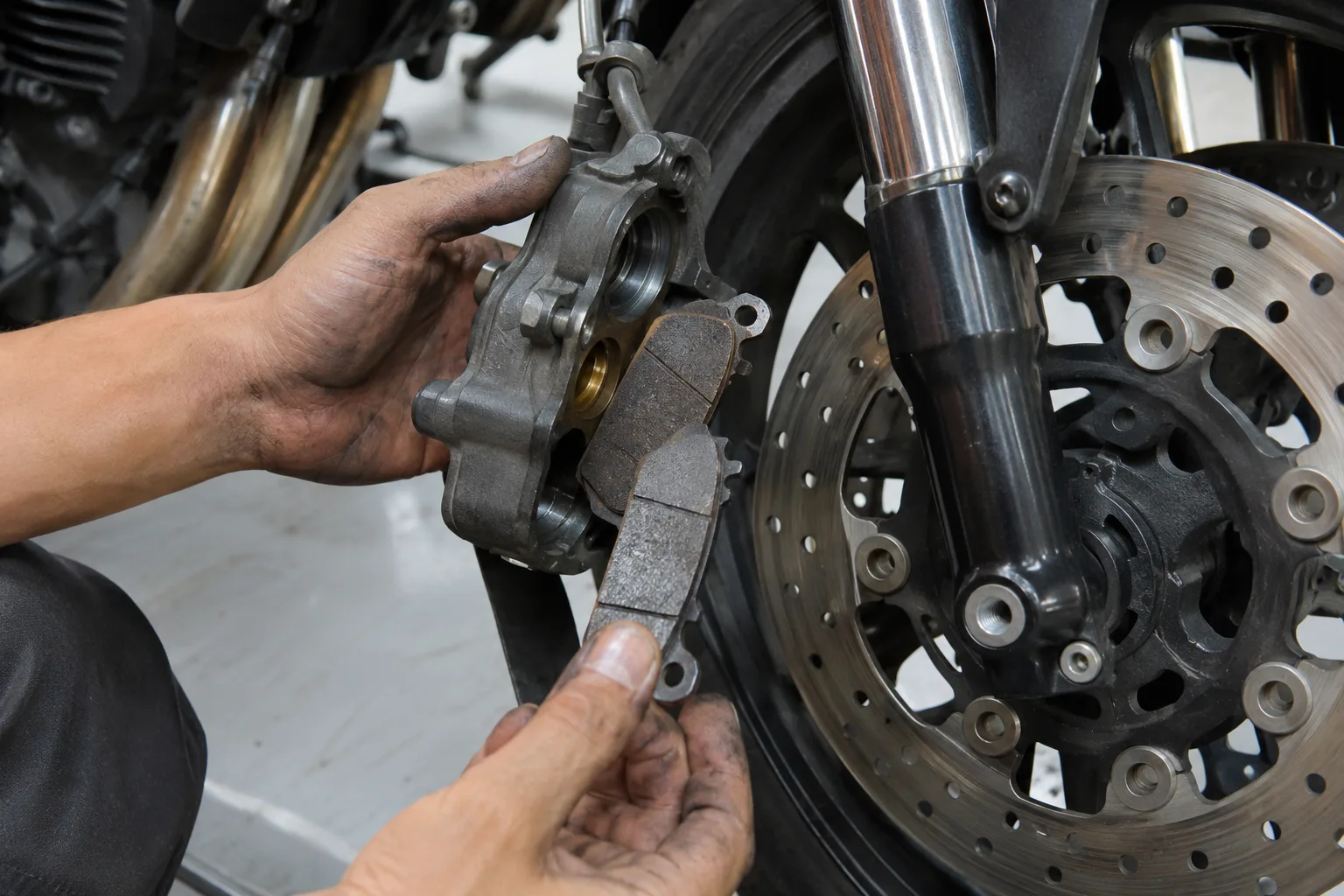
- Removing the caliper or the pad retaining pins, depending on design
- Pushing the pistons back and checking they move freely rather than sticking
- Cleaning the caliper and the pad seats of brake dust and corrosion
- Measuring the disc thickness against the minimum stamped on it
- Fitting new pads, reassembling and torquing caliper bolts to spec
- Pumping the lever to reseat the pistons before the bike is moved
- A road test, and a bed-in procedure on the new pads
That piston check is the step worth caring about. A caliper piston that does not retract leaves the pad touching the disc permanently - it eats the pad, overheats the fluid and costs you fuel. If one pad is much more worn than its partner in the same caliper, that is what is happening, and pads alone will not fix it.
When the bill goes up
Discs out of spec
Motorcycle discs are thin and have a minimum thickness stamped into them. Pads run down to the backing plate will groove a disc, and a disc below minimum is not safe to keep. Published shop lists generally do not include discs, so this is a separate line - ask for the measured figure before agreeing to it.
Caliper rebuild or seized pistons
A caliper with corroded or seized pistons needs seals, cleaning and reassembly, not just pads. On a bike that has sat outside for seasons this is common enough to expect.
Old brake fluid
Brake fluid is hygroscopic and the service manual gives a change interval independent of pad wear. The $50-$75 bleed is cheap insurance when the system is already being opened, and it is worth doing on schedule regardless.
ABS systems
Pad replacement itself is unchanged by ABS, but a full fluid flush on an ABS bike can require a specific procedure to get fluid through the modulator. Ask whether the quoted bleed covers that on your bike.
Pad compound choices
- Organic / resin. Gentle on discs, quieter, less bite, shorter life. Fine on light or vintage bikes.
- Sintered metal. Strong bite, works wet and hot, the common choice on modern street bikes. Harder on discs.
- Ceramic. Quiet with low dust, generally a street rather than track choice.
Matching what the manufacturer fitted is the safe default. If you are changing compound, change both pads in a caliper and bed them in properly.
Bundling the job
The wheel does not have to come off for most pad changes, but if it is already out for a tire replacement or a chain and sprocket set, pads are an easy add with overlapping labor. Pads also usually feature on the checklist for a scheduled service, so if a service is close, ask for one combined quote rather than two.
Questions worth asking before you book
- Is that price per end or for both ends?
- Are pads included in the figure or billed separately?
- Will you measure the discs and tell me the numbers?
- Does the quote include a fluid bleed, and is my fluid past its interval?
- Will you check the caliper pistons retract freely?
- Which pad compound are you fitting, and is it what the manufacturer specified?
A note on these numbers
Trustworthy, current pricing for motorcycle service is harder to find than for cars. Much of what is published online is undated, aggregated from forums, or written for a different market. The figures here come from one shop's published price list and from general service guides, and are indicative only - a quote for your year, make and model from a local shop is the number that matters.
Frequently asked questions
Why do front pads cost more than rear?
Because most bikes have two front calipers and one rear. Twin front discs mean two sets of pads and twice the caliper work, so the front is a bigger job even though the procedure per caliper is identical. On a single-front-disc bike the gap largely disappears.
Do I need a brake fluid bleed at the same time?
Not always, but it is often the right call. One shop's list adds $50-$75 for a bleed. Brake fluid absorbs moisture over time, and the service manual gives a replacement interval regardless of pad condition. If the fluid is dark or past its interval, doing it while the system is already open is the cheap moment.
Can I replace just the pads, or do the discs need doing too?
Pads alone is the normal job. Discs come into it when they are below the minimum thickness stamped on them, warped, or deeply grooved by pads that were run to the backing plate. A shop should measure the disc rather than guess - that measurement is what decides it.
How do I know the pads are due?
Look at them. Motorcycle calipers usually let you see the pad edge without removing anything. Most pads have a wear groove or step; past that, replace. Other signs are a lever that travels further than it used to, a squeal or grinding under braking, and a noticeable drop in stopping power.
Sources
- Motorhelmets - Street and sport bike service pricing
- J.D. Power - How much does it cost to service a motorcycle
- Support Bikers - Motorcycle yearly maintenance guide
- Cardo Systems - Motorcycle maintenance costs
Get an estimate for your bike
Snap the problem and get an itemized estimate with parts and labor in minutes.
More in repair costs