Motorcycle chain and sprocket cost
Updated 2026-11-07 · By the Motorcycle Repair Estimator team
Replacing a motorcycle chain and both sprockets at a shop typically runs about $250-$600 all in, with the parts themselves accounting for roughly $150-$400 of that. The spread comes down to chain quality, sprocket material and how awkward the front sprocket is to reach on your bike. These figures are indicative and worth checking against a local quote.
What a chain and sprocket job costs
This is one of the more predictable motorcycle jobs to price, because it is almost always quoted as a complete set rather than piece by piece. The table splits the published figures into parts and the whole job.
| Item | Indicative cost | Notes |
|---|---|---|
| Chain and sprocket set, parts only | $150-$400 | Chain plus front and rear sprocket |
| Chain and sprocket set, fitted at a shop | $250-$600 | Parts and labor together |
| Shop labor rate, independent | $70-$120 per hour | If billed hourly rather than flat rate |
| Shop labor rate, dealership | $125-$250 per hour | Around $130 per hour commonly quoted |
Subtract the parts from the whole job and the implied labor is modest - this is not a long job on most bikes. Where a quote comes in near the top of the range, it is usually because the parts chosen were premium, the bike buries the front sprocket, or the shop is a dealership billing at dealership rates.
Why it is sold as a set
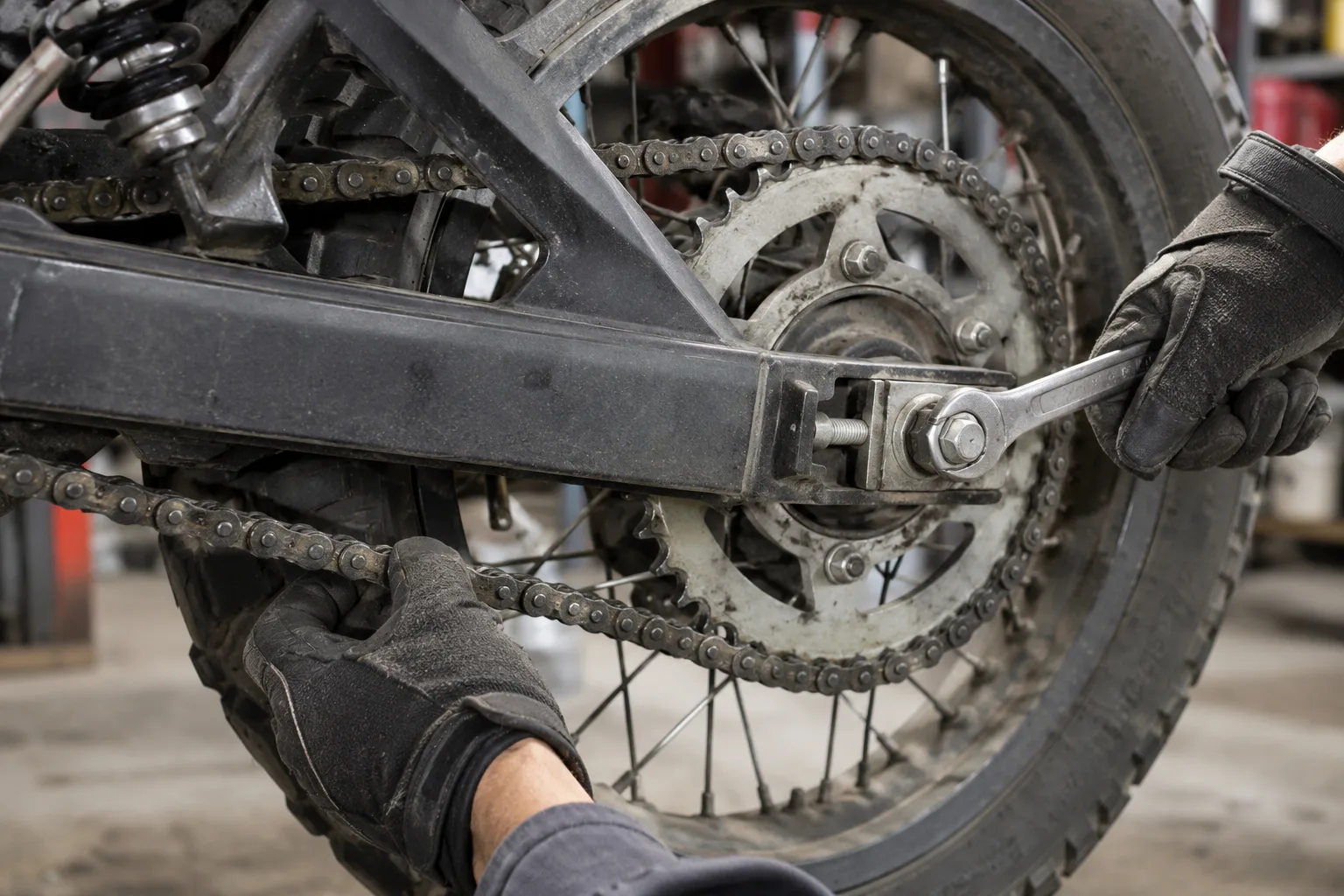
A drive chain and its two sprockets wear as a system. As the chain stretches, its pitch no longer matches the sprocket teeth exactly, and the mismatch wears the teeth into a hooked profile. Put a new chain on hooked sprockets and the new chain takes that wear immediately; put old chain on new sprockets and you have paid for parts you are about to ruin.
There is a narrow exception. If a chain failed early through neglect - rust, a seized link, a snapped master link - and the sprocket teeth are still symmetrical and sharp, replacing the chain alone can be legitimate. Ask the shop to show you the teeth rather than taking it on faith in either direction.
What drives the price
Chain type
Plain chains are cheapest and need the most maintenance. O-ring chains seal grease into the pins and last considerably longer. X-ring chains use a different seal profile for less drag and longer life again, and sit at the top of the parts range. On a bike you ride regularly, the sealed chain is generally the better value even though it costs more up front.
Sprocket material
Steel rear sprockets cost less and outlast aluminum. Aluminum is lighter, which matters on a sport bike and matters very little on a commuter. The front sprocket is nearly always steel because of the load it carries.
Access to the front sprocket
The rear sprocket is bolted to the wheel hub and is easy to reach. The front sits behind a cover, sometimes behind a shift linkage, a clutch slave cylinder, or bodywork. That is the labor variable. A naked standard is quick; a faired bike with a crowded left side is not.
Rivet versus clip master link
Most shops fit a riveted master link, which requires a chain tool and is the stronger joint. A clip link is faster but is generally considered acceptable only on lower-powered bikes. If a quote is unusually cheap, it is fair to ask which it is.
What the labor covers
- Lifting the bike and loosening the rear axle
- Removing the front sprocket cover and any linkage in the way
- Breaking the old chain and removing it
- Replacing the front sprocket and torquing its retaining nut or bolts
- Removing the rear wheel or sprocket carrier and fitting the new rear sprocket
- Sizing and riveting the new chain to the correct length
- Setting chain tension and rear wheel alignment, then torquing the axle
- A road test and a slack recheck once the chain has settled
That last point matters. A new chain beds in over the first few hundred miles and will need a tension check. Some shops include it; most do not say either way unless asked.
Signs the set is due
- Tight spots - slack that changes noticeably as you roll the wheel through a full turn
- A chain you can pull away from the back of the rear sprocket far enough to see daylight under a tooth
- Hooked or pointed sprocket teeth instead of symmetrical ones
- Stretch beyond the service manual's measured limit over a specified number of links
- Rust, stiff links, or a chain that will not hold adjustment
- Rapid rear tire wear or a bike that feels like it is hunting under power
Bundling the job
The rear wheel is already off or loose for this work, which makes it the cheapest moment to also fit a rear tire or deal with rear brake pads. If any of those are even close to due, ask for a combined price - the overlapping labor is the saving. The same principle shows up across scheduled motorcycle service: pay once for access, do everything behind it.
Questions worth asking before you book
- Is this quoted as a set, and which chain and sprockets are you fitting?
- Riveted or clip master link?
- Steel or aluminum rear sprocket?
- Is rear wheel alignment included, and how is it set?
- Is a follow-up tension check after bed-in included?
- If the rear wheel is coming out anyway, what would a tire or brake pads add?
A note on these numbers
Trustworthy, current pricing for motorcycle service is harder to find than for cars. Much of what is published online is undated, aggregated from forums, or written for a different market. The ranges here are compiled from service guides and maintenance cost write-ups and are indicative only - a quote for your year, make and model from a local shop is the number that matters.
Frequently asked questions
Can I replace just the chain and keep the sprockets?
You can, but shops generally advise against it and most quote the job as a set. A worn sprocket has hooked teeth that will chew a new chain quickly, so the saving is usually temporary. The exception is a chain that failed early from neglect while the sprockets are genuinely still sharp and low-mileage.
How long should a chain and sprocket set last?
There is no single figure worth publishing - it depends almost entirely on lubrication, cleaning, correct tension and riding style. A well-kept O-ring or X-ring chain lasts a great deal longer than a neglected one of the same part number. Measure stretch and inspect the teeth rather than going by mileage.
What does the parts cost cover?
A chain and both sprockets. Published parts figures of roughly $150-$400 reflect the range from a basic set to a premium X-ring chain with quality sprockets. Steel rear sprockets cost less and last longer than aluminum; aluminum saves weight and is popular on sport bikes.
Is the labor rate the main variable?
Not usually - access is. Independent shop rates run roughly $70-$120 an hour and dealerships $125-$250, but the bigger difference between two quotes is often how much has to come off the bike to reach the front sprocket behind its cover.
Sources
- J.D. Power - How much does it cost to service a motorcycle
- Support Bikers - Motorcycle yearly maintenance guide
- Cardo Systems - Motorcycle maintenance costs
- RIVA Motorsports - Service center labor pricing
Get an estimate for your bike
Snap the problem and get an itemized estimate with parts and labor in minutes.
More in repair costs