Motorcycle tire replacement cost
Updated 2026-11-07 · By the Motorcycle Repair Estimator team
Labor to mount and balance a motorcycle tire runs roughly $20-$35 per wheel if you carry the loose wheel into the shop, and roughly $70-$120 per wheel if the shop removes and reinstalls the wheel for you. A complete two-tire job with tires included is commonly quoted around $300-$600. All of these are indicative - tire prices alone swing by hundreds of dollars between a commuter bike and a liter sportbike.
What motorcycle tire replacement costs
Tire pricing splits cleanly into two numbers that shops quote separately: the tire, and the labor to fit it. Published labor figures are reasonably consistent. Tire prices are not, and no honest table can give you one.
| Item | Indicative cost | Notes |
|---|---|---|
| Mount and balance, wheel off the bike already | $20-$35 per wheel | You carry the loose wheel in |
| Mount and balance, shop removes the wheel | $70-$120 per wheel | Includes removal, reinstall, torque |
| Mount and balance, per-tire figure from a 2026 guide | $15-$60 per tire | Source does not state whether the wheel is off |
| Two tires fitted at a shop, tires included | $300-$600 | Whole job; varies most with tire choice |
| Shop labor rate, independent | $70-$120 per hour | Relevant if quoted hourly rather than flat |
| Shop labor rate, dealership | $125-$250 per hour | Around $130 per hour is commonly quoted |
The sources behind these figures do not fully agree. One published 2026 page gives $15-$60 per tire for mounting and balancing without saying whether the wheel is already off the bike, which would explain most of the gap with the $20-$35 and $70-$120 figures from shop-practice discussions. Where they do agree is the shape of the thing: pulling the wheel yourself is the single biggest lever on the labor line.
Wheel off versus wheel on
You bring the wheel in
The shop breaks the bead, strips the old tire, fits and seats the new one, balances it and hands the wheel back. That is a short bench job and it is priced like one. If you own a paddock stand and a socket set, this is the cheapest route by a large margin - and it is the route most riders with a second vehicle take.
The shop pulls the wheel
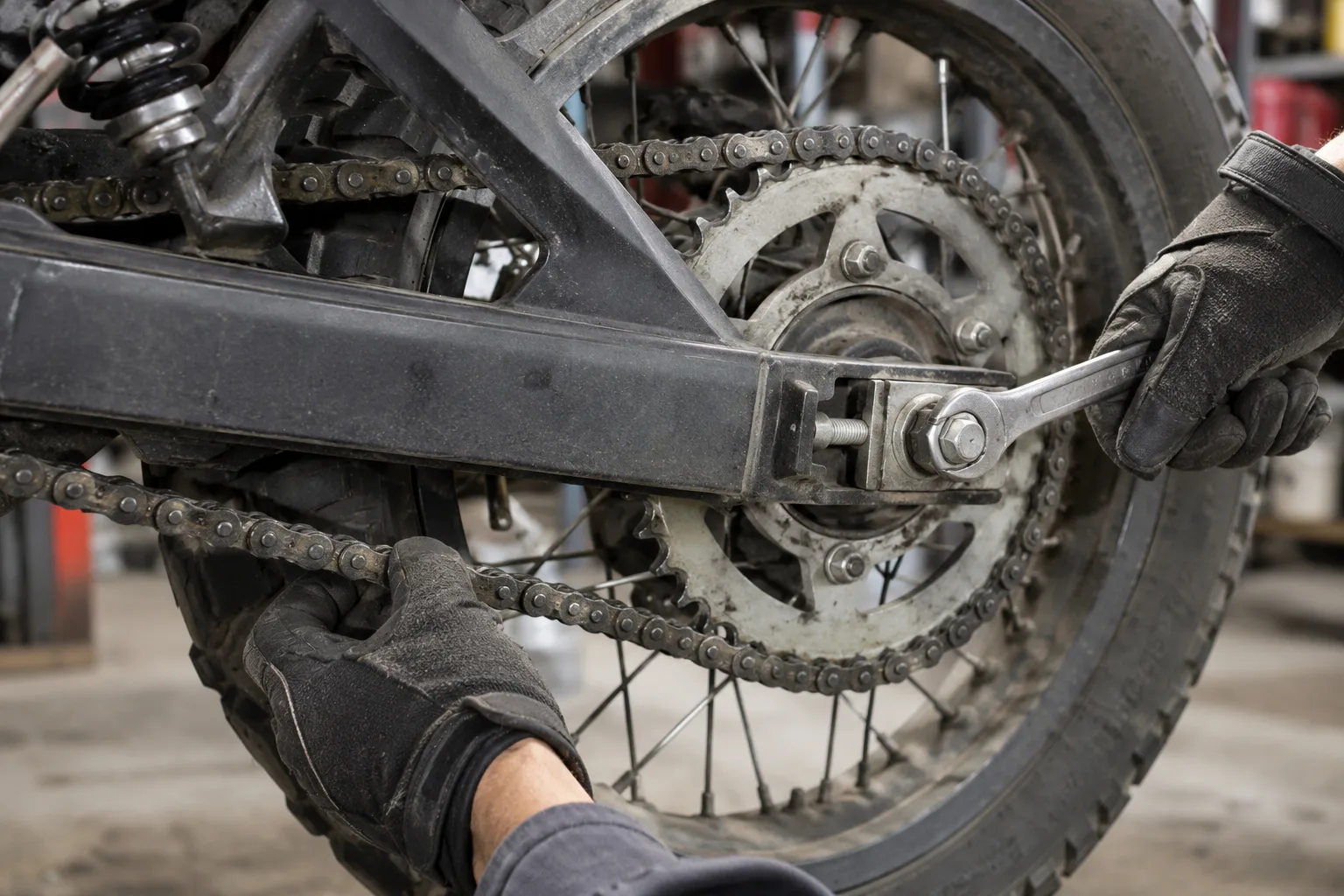
Now the labor includes getting the bike up, removing a wheel with brake calipers and possibly ABS sensors in the way, reinstalling it to the correct axle torque, and on a chain bike resetting chain tension and alignment. On a rear wheel with a shaft drive or a single-sided swingarm the time differs again. This is why the per-wheel figure roughly triples.
If the shop is already doing a chain and sprocket replacement, the rear wheel is coming off anyway. Bundling a rear tire into that job is close to free labor, and the same logic applies when the wheel is out for brake work.
Why tire prices vary so much
- Size. A 190-series rear for a liter bike costs substantially more than a 140-series rear for a mid-size standard.
- Compound and category. Sport, sport-touring, touring, cruiser, dual-sport and knobby tires are different products at different prices, even in the same size.
- Tube versus tubeless. Spoked wheels with tubes add a tube to the parts list and a little more fitting care.
- Front versus rear. Rears are wider and generally cost more, which is also why they wear faster in use.
- Where you buy. Buying tires online and bringing them to a shop can lower the parts cost, though some shops charge more to fit customer-supplied tires or decline to do it. Ask first.
What the labor actually includes
- Breaking the bead and removing the old tire without scoring the rim
- Inspecting the rim, valve stem and, on spoked wheels, the rim tape and tube
- Mounting the new tire with the rotation arrow and balance mark correctly oriented
- Seating the beads to the specified pressure
- Static or dynamic balancing, with weights as needed
- On a wheel-on job: reinstall, axle torque to spec, chain tension and alignment, brake check
Two details are worth confirming on the invoice. A new valve stem is cheap and is the right time to replace it; so is rim tape on a spoked wheel. Neither is always included.
When to replace rather than wait
Tread depth is the obvious trigger - ride to the wear bars and no further. But motorcycle tires also come off the bike for reasons a car tire would not:
- Age. Rubber hardens over years regardless of mileage. A tire with plenty of tread on a bike that sat for six seasons is not a good tire.
- Squared-off profile. Heavy highway use flattens the center while the shoulders stay new. The tire still has tread and still handles badly.
- Cupping or scalloping. Usually a front-tire symptom, often tied to suspension condition. If you are seeing it, have the forks looked at too - see fork seal replacement cost.
- Punctures and plugs. A plugged motorcycle tire is a get-home measure, not a repair. Most manufacturers do not endorse it.
Questions worth asking before you book
- Is the quote for the wheel off the bike or on it?
- Is balancing included, or billed separately with weights?
- Is there a disposal fee per tire?
- Do you fit customer-supplied tires, and is the labor rate different if I bring them?
- Will you set chain tension and alignment after the rear wheel goes back on?
- Is a new valve stem, or rim tape on a spoked wheel, part of the price?
A note on these numbers
Trustworthy, current pricing for motorcycle service is harder to find than for cars. Much of what is published online is undated, aggregated from forums, or written for a different market. The labor ranges here come from shop-practice discussions and one 2026 pricing page whose basis is not fully clear, and the tire prices themselves vary far too widely to publish as a single figure. Treat everything above as indicative only - a quote for your year, make, model and tire choice from a local shop is the number that matters.
Frequently asked questions
Is it cheaper to bring the wheel in myself?
Yes, usually by a wide margin. Published labor for mounting and balancing a loose wheel is roughly $20-$35, while having the shop remove the wheel from the bike and reinstall it is roughly $70-$120 per wheel. The difference is the removal and reinstall labor, which includes axle torque and, on the rear, chain or belt adjustment.
Should I replace both tires at once?
Not necessarily on cost grounds. Rear tires normally wear out well before fronts, and replacing only the rear is routine. Replace both when both are near the wear bars, when one is aged or damaged, or when you want a matched front and rear from the same model line, which many tire makers recommend for handling.
How much of the bill is the tire itself?
Often most of it. Labor to mount and balance is a modest, fairly predictable figure; the tires are where the money goes, and prices vary enormously by size, compound and brand. Get the tire price and the fitting labor quoted separately so you can compare shops honestly.
Do I need the old tires disposed of?
Most shops handle disposal and some add a small per-tire fee for it. It is minor compared to the tire and labor, but ask so it is not a surprise line on the invoice. Published pricing guides rarely include it in their headline numbers.
Sources
- PowerSports Guide - Cost to change motorcycle tires
- J.D. Power - How much does it cost to service a motorcycle
- Support Bikers - Motorcycle yearly maintenance guide
- RIVA Motorsports - Service center labor pricing
Get an estimate for your bike
Snap the problem and get an itemized estimate with parts and labor in minutes.
More in repair costs