Free motorcycle repair invoice template
Updated 2026-11-07 · By the Motorcycle Repair Estimator team
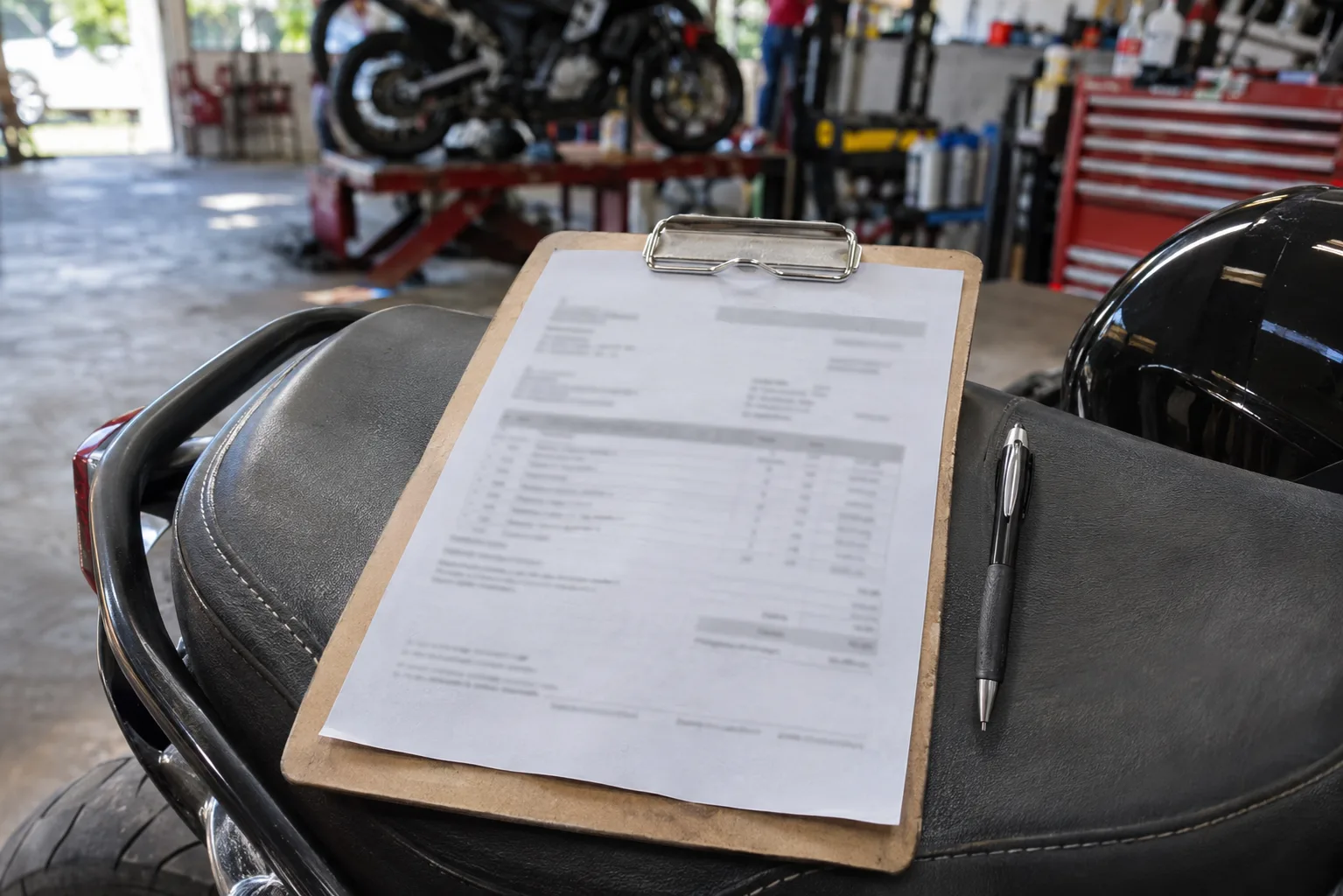
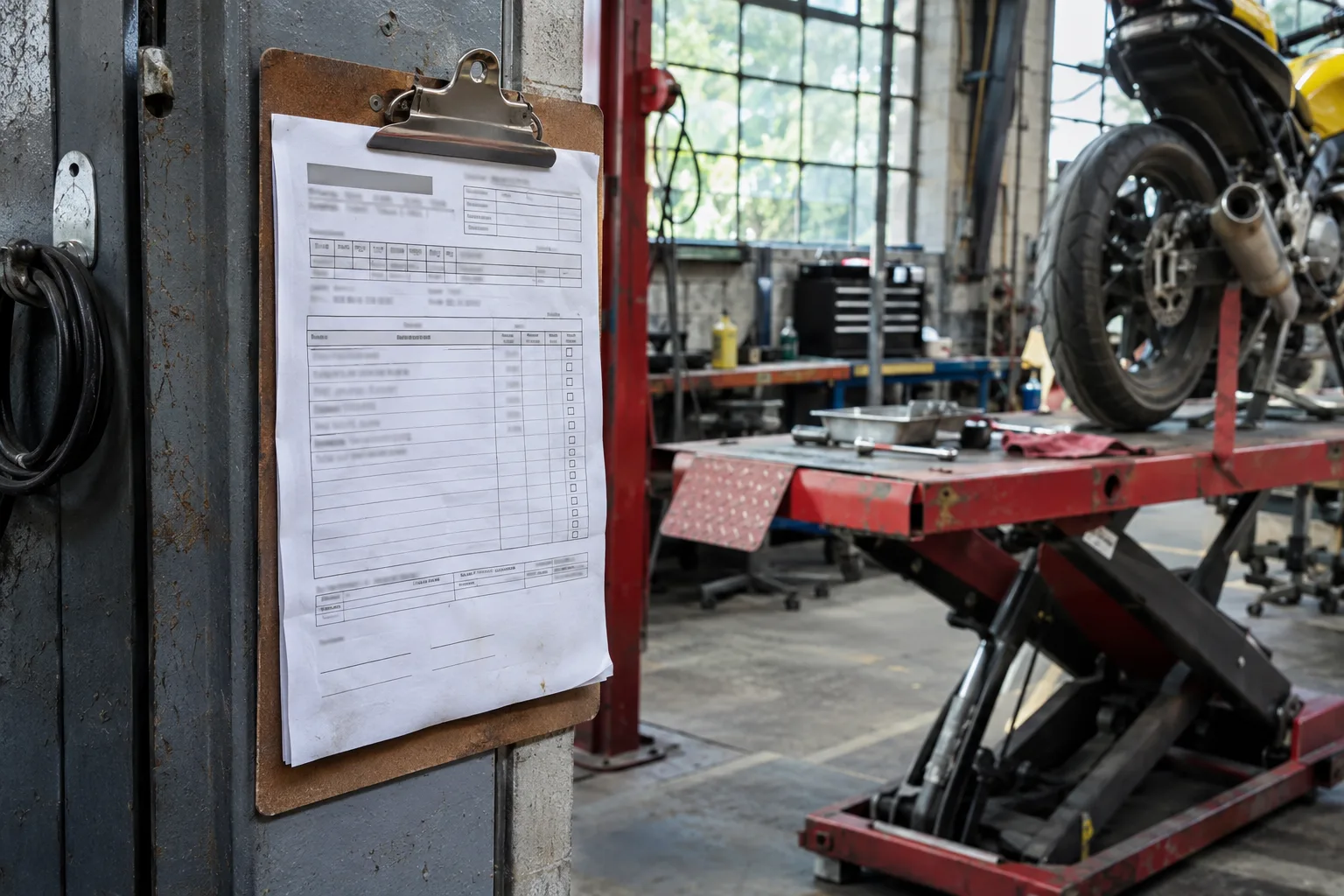
Fill in your shop, the customer, the machine and the line items below and download a finished invoice as a PDF, or print the blank version for the counter. Below the generator is a section-by-section checklist of what a complete motorcycle repair invoice should show, and the two lines that cause nearly every dispute.
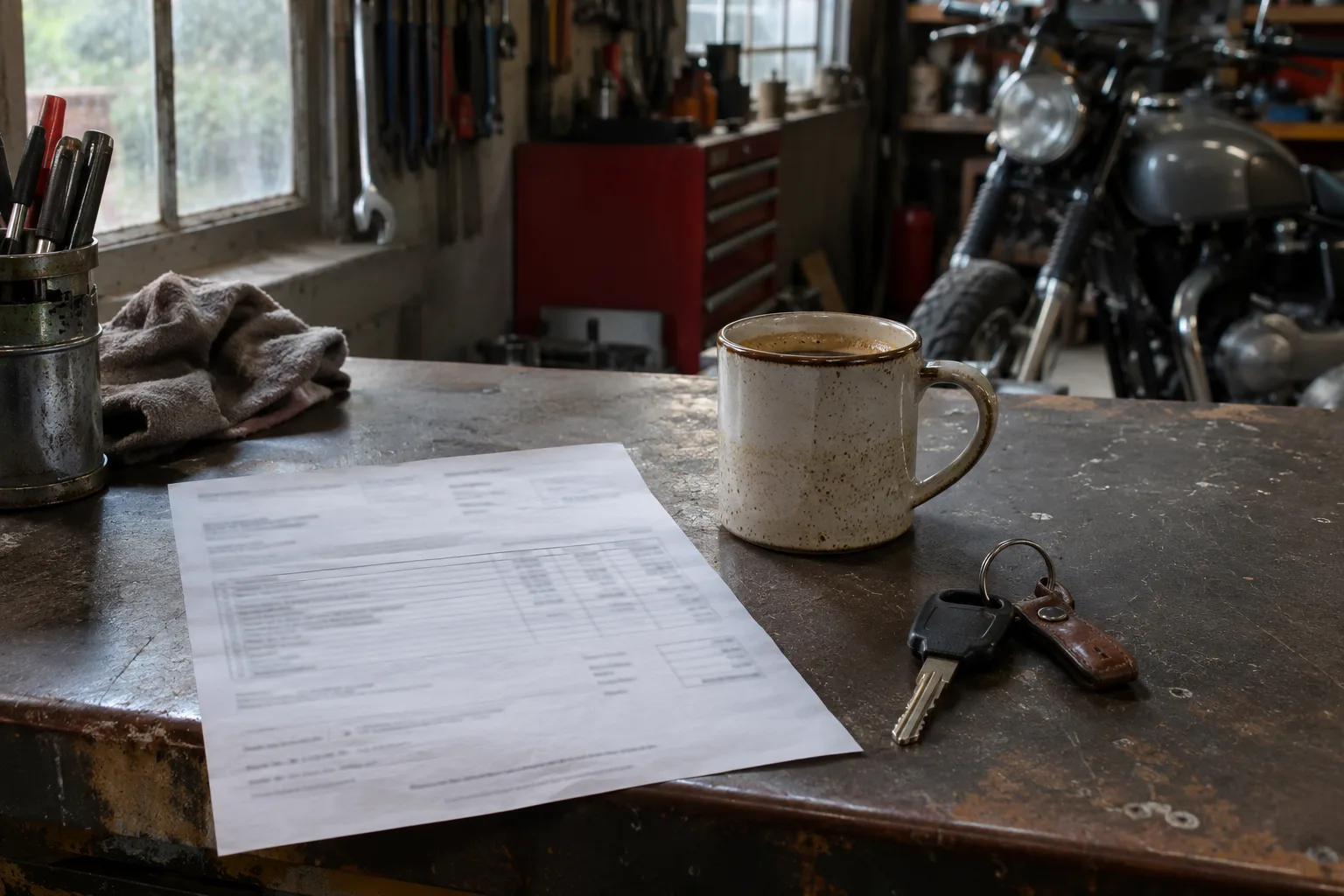
A clear invoice gets you paid faster and settles most "what was this charge for?" calls before they happen. Use the generator to build an invoice with separate lines for teardown, labor, parts, consumables and shop supplies, add tax and notes, and download a PDF. If you prefer paper, download the blank version.
What a motorcycle repair invoice should include
The invoice is the permanent record of the job. It should let the customer, a future buyer, or you in two years' time see exactly what was done, with what parts, for how much.
1. Shop information
Business name, street address, phone, email and your state registration or license number if your state registers repair businesses. Add a sequential invoice number and the date — sequential numbering makes warranty lookups and bookkeeping far easier.
2. Customer and machine
Customer name, phone and email. Then the bike: year, make, model and variant, VIN, and odometer at drop-off. Variant matters, because calipers, fork diameters and engine internals change inside a single model name. The odometer protects you if mileage is later queried.
3. Teardown and access
Its own line, with hours and rate, charged once for everything done underneath. On a faired bike this is often the largest labor line, and it is what makes the rest of the total make sense. Burying it inside the repair labor is how a service starts looking arbitrary.
4. Labor, by operation
One line per operation with the hours charged and the rate: "Replace front fork seals, both legs, 2.5 hrs x rate." Keep diagnostic time on a separate line at its own rate if you bill it differently. It is far easier to defend a bill where the customer can see three hours of access and two hours of repair than one lump labor figure.
5. Parts, itemized
Every part on its own line with quantity, part number where you have it, description, unit price and extended price, and the type stated: OEM, aftermarket with the brand, used, or rebuilt. On brakes, tires and suspension, the type on the invoice is the record of a safety decision, so do not leave it blank.
6. Consumables, with quantities
Each fluid and filter gets a line with quantity and specification: engine oil and grade, oil filter, brake fluid and DOT rating, fork oil volume and weight, coolant, chain lube, gaskets, crush washers, plugs, air filter. These are materials bought for this machine. Rolling them into labor hides a real cost and makes the labor line look inflated.
7. Sublet work
Anything you sent out — wheel truing, machine work, powder coating, seat upholstery, tire fitting if you do not do it in house — goes on a sublet line with the vendor named. Customers accept a sublet charge far more readily when they can see who did the work.
8. Shop supplies and disposal
Shop supplies as a named line with the calculation stated, typically a percentage of labor with a cap. Waste disposal and tire disposal fees as their own named lines, and if a fee is set by a government mandate, identify it by name and amount rather than hiding it in a percentage. See motorcycle shop supplies fee.
9. Subtotals, tax and total
A parts subtotal, a labor subtotal, then tax, then the total. Showing the two subtotals separately makes clear what was taxed, which matters because states treat parts and labor differently.
10. Payment terms and warranty
Amount paid, balance due, due date and accepted methods. Then your warranty: what it covers (parts, labor or both), for how long or how many miles, and what it excludes. State separately that you cannot warrant parts the customer supplied. A one-line warranty statement prevents most comebacks from turning into arguments.
11. Signature and reference to the approval
A signature line acknowledging pickup and the charges, plus a reference to the estimate or repair order the customer authorized. If extra work was approved by phone, note who approved it, when and for how much.
The two lines that cause the disputes
In motorcycle work, almost every invoice argument is about one of two things.
Teardown the customer thought was included
The fix is entirely upstream: the teardown line, with hours, on the estimate they approved, together with a statement of what they owe if they decline the repair once the machine is apart. If it was on the estimate, the invoice is just collecting what was agreed.
Consumables and supplies charged twice
If the fork oil appears as a consumable line and the supplies percentage is also described as covering fluids, you have a problem the customer will find. Pick one home for each item: measurable quantities go on consumable lines, unmeterable background goes in the percentage, and the invoice never shows the same material in both places.
Keep the invoice matched to the estimate
The estimate is the quote, the repair order is the authorized work the technician follows, and the invoice is what gets paid. It should equal the approved estimate plus any separately approved addition — nothing else. Keeping the three consistent is the simplest dispute-avoidance tool available, and it costs nothing.
State disclosure rules
Requirements vary by state, and by whether motorcycle repair falls inside your state's automotive repair statute. Several states specify invoice content: parts and labor listed separately with separate subtotals and tax, part condition stated where a part is used or rebuilt, and a copy given to the customer. Others have no invoice-specific rules. Building to the stricter standard keeps you covered if you expand or a customer complains. Check your state's automotive repair or consumer protection agency.
Skip retyping the job
If you already write estimates on your phone, Motorcycle Repair Estimator Moto+ converts an approved estimate into an invoice with teardown, labor, parts and consumables already on separate lines, sends it as a branded link or PDF, and tracks whether it has been paid. Set your numbers first with the labor rate calculator.
Frequently asked questions
What should be on a motorcycle repair invoice?
Shop name, address, phone and state registration number if your state issues one; invoice number and date; customer contact; the bike's year, make, model, variant, VIN and odometer; teardown as its own line; each labor operation with hours and rate; parts with quantity, type and price; consumables with quantities; sublet with the vendor named; shop supplies with the calculation stated; parts and labor subtotals; tax; total; payment terms; and your warranty on parts and labor.
Should parts and labor be listed separately?
Yes. Separate subtotals make it obvious what was taxed, and many states tax parts and labor differently. It is also the only way a customer can see that a large total is mostly access labor rather than an inflated parts markup.
Do I have to list used or aftermarket parts?
Some states require part condition and type to be stated on the invoice, and it is good practice everywhere. On a motorcycle it matters more than on a car, because part type on brakes, tires and suspension is a safety question that may come up again later.
Is this invoice template free?
Yes. The generator and the blank printable PDF on this page are free to use.
Invoice from the estimate you already wrote
Motorcycle Repair Estimator turns an approved estimate into an invoice and tracks what has been paid.
More in for shops