Free motorcycle repair order template
Updated 2026-11-07 · By the Motorcycle Repair Estimator team
Create a motorcycle repair order below with the customer's concern, the authorized work and amount, the teardown terms and a signature line, then download it as a PDF. Below the generator: what to capture at drop-off, how to write the three Cs on a bike, and why the teardown authorization is the line that saves the job.
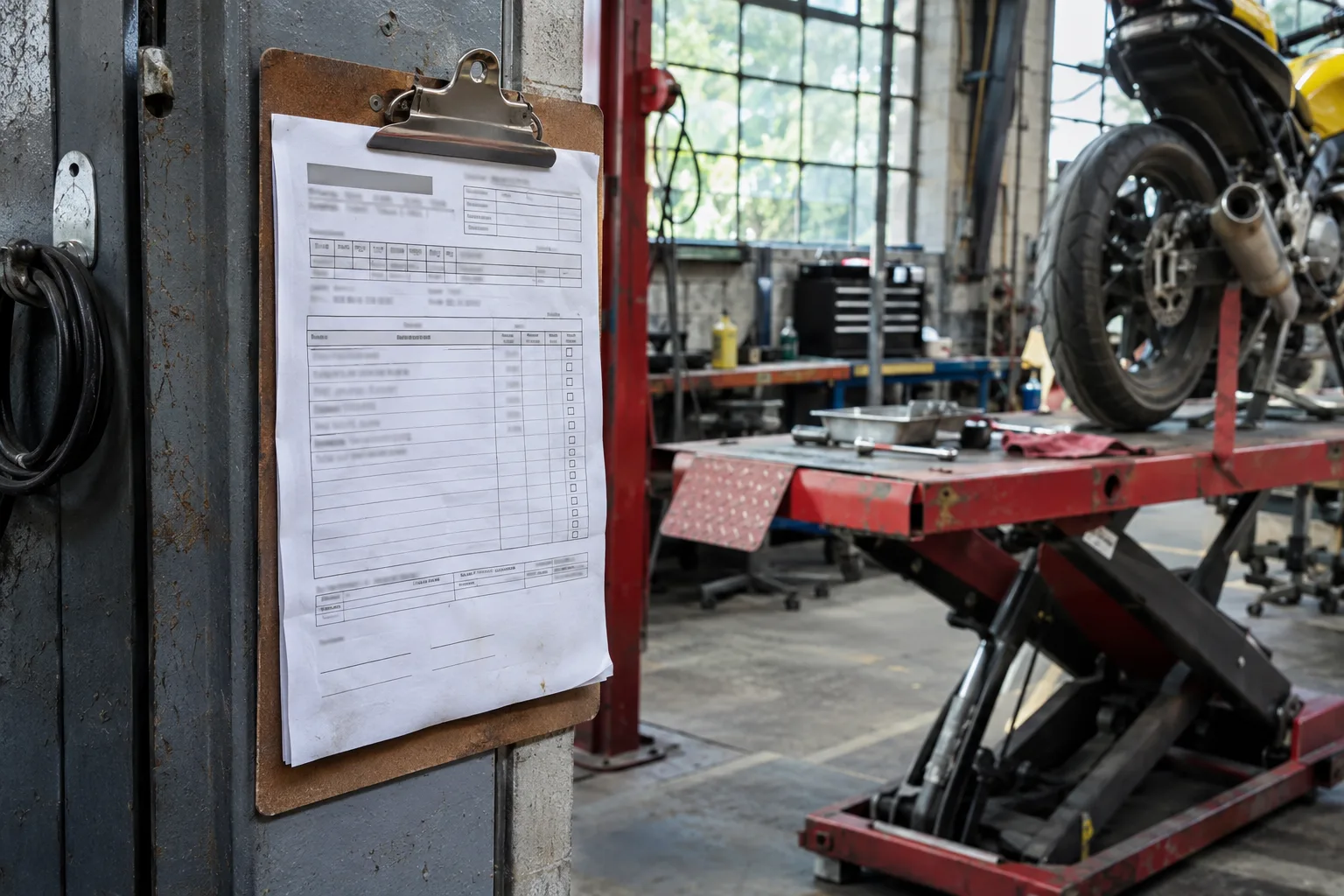
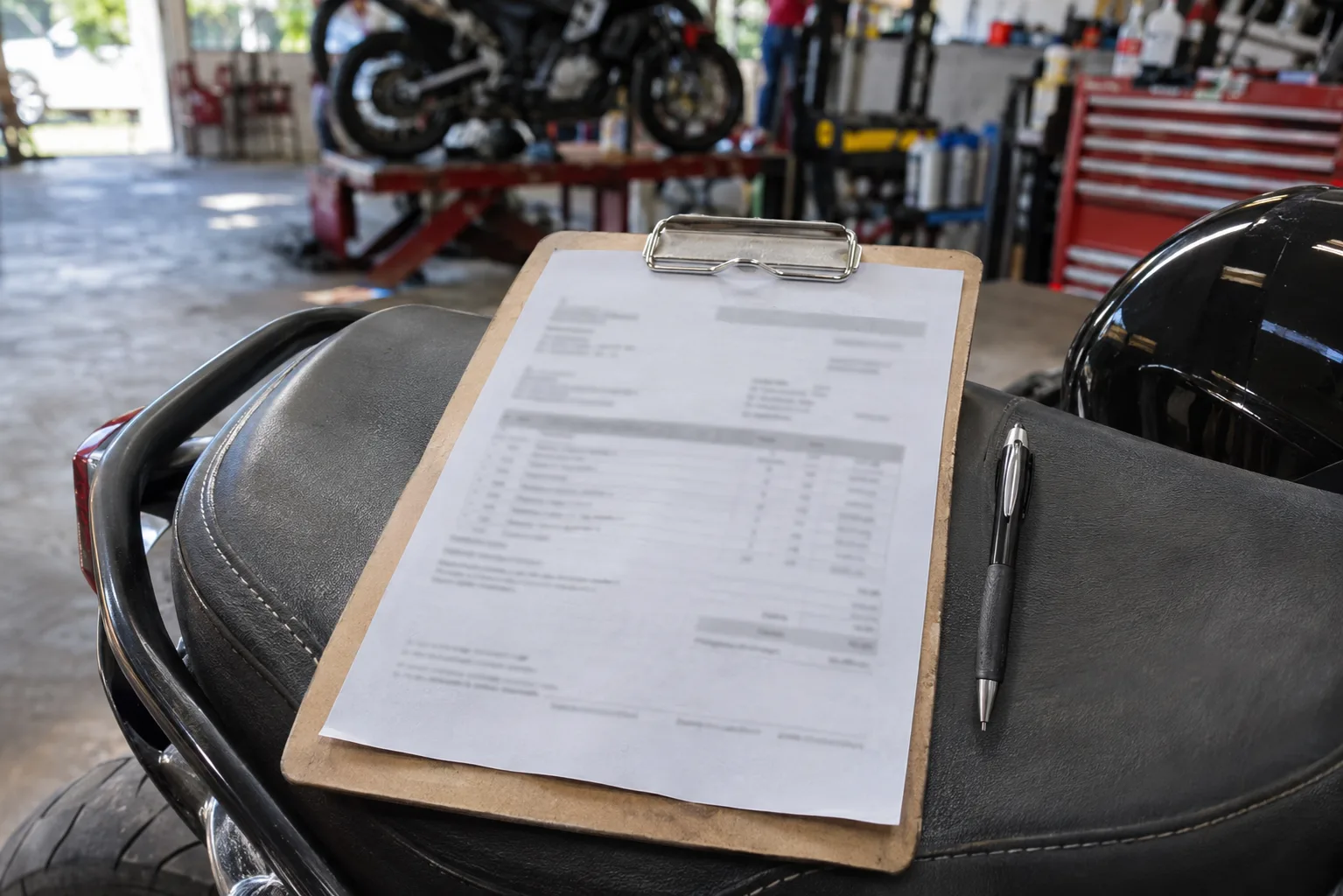
The repair order is where a job becomes official: what the customer reported, what they authorized and up to what amount, the condition of the bike on arrival, and what the technician found. Fill in the generator for a clean work order with a signature line, or print it blank for the counter.
What to capture at drop-off
Most comebacks and disputes trace back to a thin repair order. Before the keys go on the board:
- Customer: name, phone, email, and how they want to be reached for approvals. A bike apart on a bench while you wait for a callback is a bay out of service.
- Machine: year, make, model and variant, VIN, odometer. Note the variant, because brakes, forks and engine internals change inside a single model name.
- Condition at drop-off: scratches and dents, cracked bodywork, broken fairing tabs, missing fasteners, corroded hardware, non-original parts, tire condition and date codes, chain adjustment, fluid levels. Timestamped walk-around photos are the easiest proof.
- Fuel level, if you will run the bike or remove the tank.
- What came with it: keys, manual, luggage, any parts the customer supplied.
- The concern, in the customer's words.
- Authorized work and amount: the approved estimate total, or a teardown-and-diagnosis authorization with a dollar limit.
- Promised time, and whether parts availability is a known risk.
- Customer signature and date.
The bodywork notes deserve attention. Fairing tabs break during removal, and a tab that was already cracked on arrival is a very different conversation if you photographed it.
The teardown authorization
This is the line a motorcycle repair order needs that a car one often does not. Teardown is labor performed before anybody knows what the repair is, and on a faired machine it can exceed the repair itself. Record:
- The teardown hours the customer approved, and the rate.
- That access is charged once for everything done underneath the same bodywork.
- What the customer owes if they decline the repair after teardown — the teardown plus reassembly.
- The not-to-exceed figure for the diagnosis, if the repair is not yet known.
Signed before the panels come off, this turns the hardest conversation in motorcycle service into a term the customer already agreed to.
The three Cs, on a bike
Technicians structure each line as concern, cause and correction. On motorcycle work, record access too, because it explains most of the labor.
Concern
What the customer reported, as specifically as possible: when it happens, at what engine or road speed, hot or cold, since when. "Rattle from the top end at 3,000 rpm once warm" gives the technician something to work with. "Engine noise" does not. Ask what has been tried — previous repairs are a common hidden cost.
Access
What had to come off: bodywork, seat, tank, airbox, radiator, exhaust, wheels. Record those hours separately from the repair hours. This is also the data that builds your own labor times, since the access time for a model is reusable on every future job under the same panels.
Cause
The root cause, with the test or measurement that proved it: "Intake valve clearances below specification" or "Left fork seal weeping, oil level low, stanchion pitted." A clear cause line justifies the correction and the parts, and it is what you will want to read if the customer comes back.
Correction
What was done: parts replaced, consumables with quantities, operations performed, torque values where they matter, and the verification. "Replaced both fork seals and dust seals, refilled with fork oil to specification, road tested, no leak at 20 miles."
Added work and approvals
The signature is permission to proceed up to the stated amount. When the technician finds more — and on a bike already apart, they usually do — stop and get approval before doing it, then record it:
- What was found, with a photo.
- The additional parts, consumables and labor, with the added total.
- Who authorized it, when, and by what means. If by phone, record the name, the date and time, and the number called.
Written approval by text or email is better, because it is self-documenting. Some states set specific requirements for recording phone authorizations, so check your own state's rules — the detail above is a good standard regardless.
Parts, consumables and labor lines
List each part with quantity, part number, type (OEM, aftermarket, used, rebuilt) and price. List consumables separately with quantities and specifications: engine oil and grade, brake fluid and DOT rating, fork oil volume and weight, coolant, gaskets, crush washers. Keep labor to one line per operation with hours and rate, teardown on its own line, diagnostic time at its own rate.
Built this way, the repair order converts cleanly into an itemized invoice with no retyping and no mismatch. Record sublet work with the vendor named.
Technician notes and deferred work
Leave room for findings outside this job: chain at the end of its adjustment range, tires near the wear bars or past their date codes, brake fluid gone dark, fork seals weeping, coolant overdue. Note them with the mileage.
These become the next estimate, they show the customer you told them, and if something you flagged fails later, the note is the record of that conversation.
Promised time, parts and status
A promised time keeps the counter honest. Powersports parts availability is less predictable than automotive, so note when a part is on back order, the expected date, and whether the bike can be reassembled to be rideable meanwhile. Update the customer and the repair order at the same moment, so whoever answers the phone sees the current status.
Estimate, repair order, invoice
These three should tell one consistent story: the estimate is the quote, the repair order is the authorized work, the invoice is the bill. For the method behind each section, read how to write a motorcycle estimate. With Motorcycle Repair Estimator Moto+, each machine keeps its estimates and invoices together and an approved estimate converts into an invoice without retyping.
Frequently asked questions
What is a repair order in a motorcycle shop?
The document that authorizes and tracks a job. It records the customer, the machine, the reported concern, the work and dollar amount the customer approved, the technician's findings, and the parts, consumables and labor actually used. It becomes the basis for the invoice.
What are the three Cs on a repair order?
Concern, cause and correction: what the customer reported, what the technician found as the root cause with the test that proved it, and what was done about it. On motorcycle work, add what came off to get there, because the access is usually the bulk of the labor.
Why does a motorcycle repair order need a teardown authorization?
Because teardown is labor performed before anyone knows what the repair will be, and on a faired bike it can be most of the job. The authorization line records that the customer agreed to the teardown hours and to what they owe if they decline the repair once the machine is apart.
Is a repair order the same as an invoice?
No. The repair order authorizes and documents the work as it happens. The invoice is the final bill. Many shops convert the completed repair order into the invoice so the two always match.
Jobs, estimates and invoices in one place
Motorcycle Repair Estimator keeps each machine's estimates and invoices together, from the first photo to paid.
More in for shops