Motorcycle invoice software
Updated 2026-11-07 · By the Motorcycle Repair Estimator team
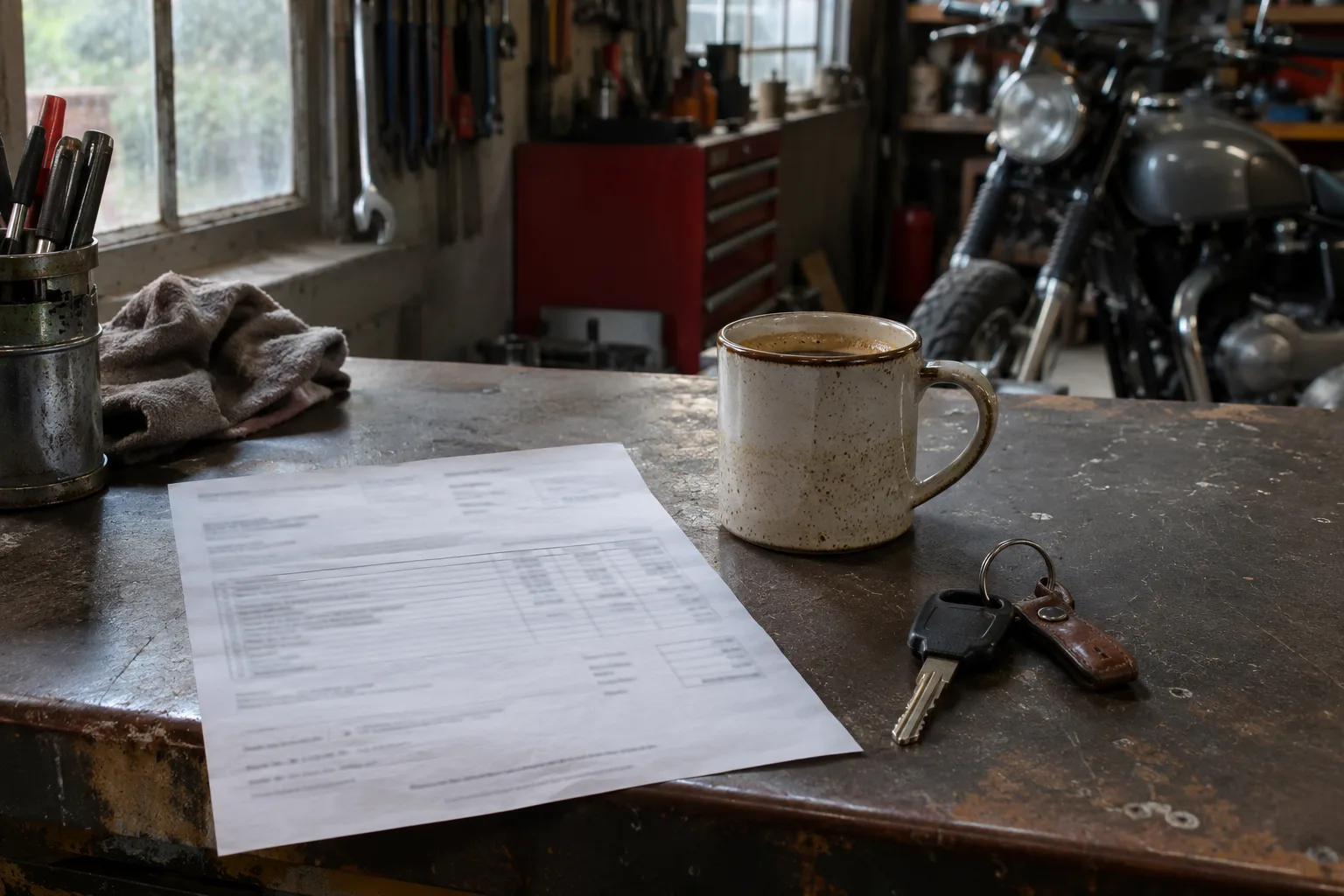
A motorcycle invoice argument is almost never about the total. It is about a line the customer does not recognize: a teardown charge they thought was included, a fork oil line they never saw on the estimate, a supplies percentage that appeared at the end. Good invoice software prevents that by building the invoice from the estimate the customer already approved.
Where motorcycle invoices go wrong
The failure is usually upstream. A customer brings in a bike for a noise, the shop quotes a diagnosis, teardown finds a second problem, the technician fixes both because the bike is already apart, and the invoice arrives with lines nobody discussed. The work was correct. The paperwork was not.
Motorcycle work is especially prone to this, for structural reasons:
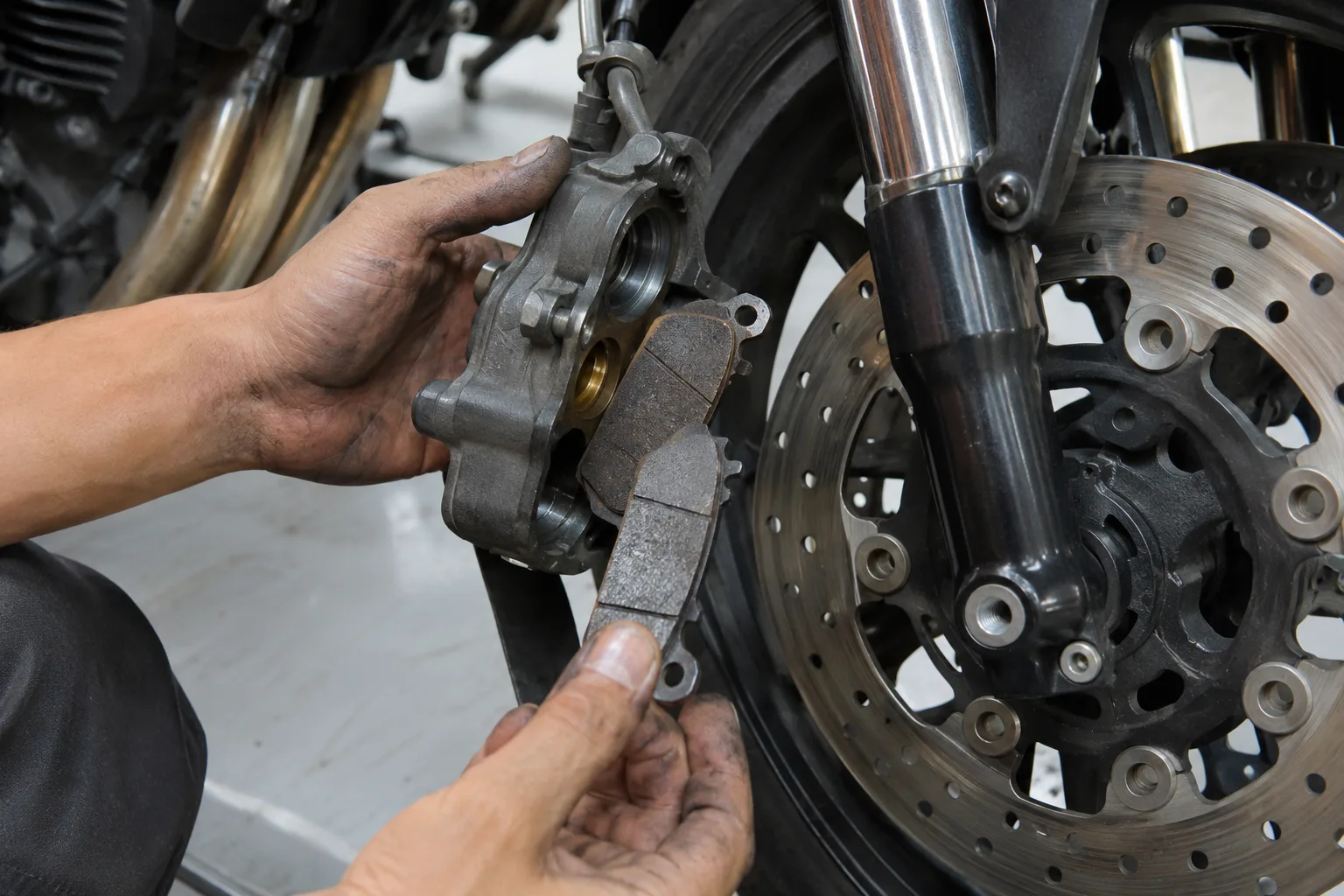
- Teardown reveals things. Once the bodywork and tank are off, you can see what you could not see from the saddle. That is useful and it is also where scope grows.
- Access is already paid for. The honest advice to do the plugs while the airbox is out is good advice, but it is also extra work the customer did not ask for.
- Older bikes fight back. A seized exhaust stud or a rounded fork cap turns a two-hour job into a four-hour job, and nobody budgeted it.
Each of those is manageable if the estimate anticipated it and the invoice traces back to the estimate.
Build the invoice from the approved estimate
The single most useful feature in invoice software for a service shop is conversion: the approved estimate becomes the invoice, with the lines, quantities and rates intact. You then add only what was separately approved. Three things follow from that:
- The customer recognizes every line, because they approved it.
- You stop retyping part numbers and fluid quantities at the end of the day.
- If there is a dispute later, the estimate, the approval and the invoice tell one story.
What belongs on a motorcycle invoice
| Section | What to show | Why it matters on a bike |
|---|---|---|
| Machine identification | Year, make, model, VIN, odometer at drop-off | Service intervals and parts fitment both hinge on the exact model year |
| Teardown / access | Its own line with hours and rate, charged once for everything underneath | It is the largest single variable in motorcycle labor |
| Labor operations | One line each, with hours and the rate applied | A lump labor figure on a bike looks arbitrary, because the customer cannot see the access time |
| Parts | Quantity, part number where you have it, OEM or aftermarket, price | Part type is a safety conversation on brakes, tires and suspension |
| Consumables | Brake fluid, fork oil, coolant, chain lube, gaskets, filters, each with quantity | Real material cost; hiding it inflates labor and loses margin |
| Sublet | Wheel truing, machine work, powder coating, with the vendor named | Customers accept a sublet charge far better when they know who did it |
| Shop supplies | The amount and the method, for example a percentage of labor | An undisclosed percentage at the bottom is the classic dispute |
| Subtotals and tax | Parts subtotal, labor subtotal, tax stated separately | Many states tax parts and labor differently |
| Terms | Amount paid, balance, methods, and your warranty on parts and labor | A one-line warranty statement heads off most comebacks |
Teardown on the invoice
Teardown is the line that most needs to exist before the work, not after. Two rules keep it defensible:
- Charge it once. If the fairing came off for a valve check and you also did the coolant and the plugs while it was apart, the access time appears a single time. Billing it per operation is double-dipping, and a customer who has read anything about motorcycle servicing will spot it.
- Say what happens if the job stops. A customer who declines the repair after teardown still owes the teardown and reassembly. That has to be on the estimate they signed, which means the invoice is just collecting what was agreed.
Consumables are not shop supplies
These two get confused constantly, and keeping them apart is what makes a motorcycle invoice readable.
- Consumables are materials bought for this bike in a measurable quantity: a liter of DOT 4, fork oil by the milliliter, coolant, a chain lube application, a crush washer, a valve cover gasket, an oil filter. Each gets a line with a quantity.
- Shop supplies are the unmeterable background: rags, solvent, brake cleaner, zip ties, gloves, waste disposal. That is what a percentage-of-labor charge covers, and around 6% of labor is a common way shops calculate it.
If a customer can point at the fork oil on the invoice and the fork oil is also inside a supplies percentage, you have a problem. Pick one home for each item and be consistent. Motorcycle shop supplies fee goes through the calculation and the disclosure habits in detail.
What to look for in the software
- Estimate-to-invoice conversion with lines and rates carried over.
- Line types that fit the trade: labor, parts, consumables with quantities, teardown, sublet, supplies.
- Multiple labor rates, so diagnostic time is not billed at the general rate if you charge differently.
- Branded output as a link or PDF, sent before the customer rides away.
- Paid tracking, so you know what is outstanding without a spreadsheet.
- History by machine, so the next visit starts with what you did last time and at what mileage.
Doing it from the phone
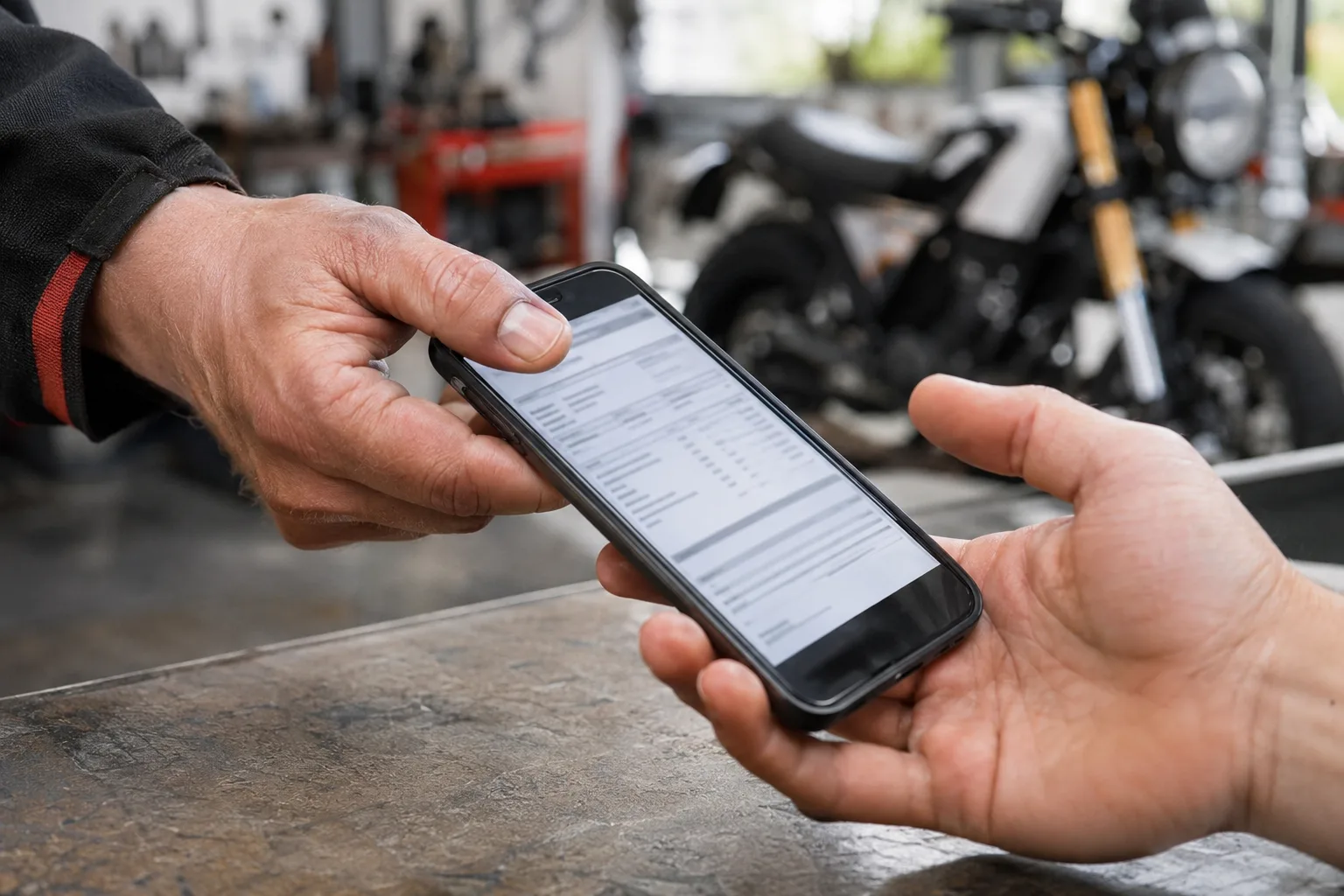
Motorcycle Repair Estimator Moto+ starts from a photo and a note, produces an itemized estimate with teardown, labor, parts and consumables on separate lines, and converts the approved estimate into an invoice. Each machine keeps its estimates and invoices together, so a customer calling back about a job from last season gets a straight answer.
Before you fill in labor lines, set your numbers with the labor rate calculator. For the blank-form route, there is a free motorcycle invoice template.
Frequently asked questions
What should a motorcycle repair invoice include?
Shop and customer details, the bike's year, make, model, VIN and odometer reading, each labor operation with hours and rate, teardown or access as its own line, parts with quantities and part type, consumables listed individually with quantities, any sublet work with the vendor named, shop supplies with the calculation stated, subtotals, tax, total, payment terms and your warranty on the work.
Should consumables be on the invoice separately?
Yes. Brake fluid, fork oil, coolant, chain lube, gaskets and filters are materials bought for that bike, with a quantity you can point to. Rolling them into labor hides a real cost and makes the labor line look inflated, which is the line customers question first.
Can I invoice a motorcycle job from my phone?
Yes. Motorcycle Repair Estimator Moto+ runs on iPhone, iPad and Android, converts an approved estimate into an invoice, sends it as a branded link or PDF, and tracks whether it has been paid.
How do I bill work the customer did not originally approve?
Not on the final invoice as a surprise. Write a dated addition to the estimate describing the extra parts and labor, get approval before doing the work, record who approved it and when, and then let the invoice reflect the approved original plus the approved addition.
Estimates and invoices in minutes
Motorcycle Repair Estimator turns a photo into an itemized estimate, then an invoice. Free to download.
More in for shops